
Key Takeaways
- Fit beats feature count. The right platform matches your program mix, reporting obligations, billing reality, and available staff.
- Public health is its own discipline, and several widely deployed platforms treat it as one specialty among dozens. That difference shows up as configuration work during implementation rather than functionality on day one.
- Pricing is rarely transparent. Most vendors here publish nothing, and the entry price diverges sharply from the total cost once modules, interfaces, per-user charges beyond the included allowance, and implementation are added.
- Independent evidence is uneven. Some platforms tout hundreds of verified reviews; though public health client representation in those reviews is often next to none. References from comparable health departments matter more than a star rating.
- CureMD, Epic, Nightingale Notes, eClinicalWorks, Netsmart, ezEMRx, Juno Health, NextGen, and Patagonia Health each serve different-sized departments and have different priorities.
Table of Contents
Top EHRs for Public Health 2027: Vendor Comparison Guide
Public health departments should not buy electronic health records (EHRs) software the way physician practices do. Public health departments document across several categorical programs, bill Medicaid alongside sliding fee scales and grant funds, and answer to funders on their schedule. An EHR platform can be excellent for use in an ambulatory primary care facility and still lack features that make it a great fit for local health departments, such as WIC, family planning, and communicable disease workflows, out of the box.
This public health EHR comparison guide evaluates nine platforms through an operational lens: what each is actually built for, what it costs once modules and interfaces are added, and what verified reviews and customer references show. It considers the full range of department size, from a rural department running a few programs to metro departments and statewide agencies balancing many programs, funding requirements, and multiple locations
If you are early in an EHR search and want a second opinion on what to ask vendors, book a 20-minute call with our public health team. We will share what we have learned from health departments that have already been through the process.
How We Compared These Nine Platforms
- Public health fit. Are public health program workflows supported at go-live, including WIC, family planning, immunizations, communicable disease, and maternal and child health, or built for you during implementation? This one distinction drives cost, timeline, and who maintains the configuration afterward, so it applies to every platform below.
- Pricing and transparency. What does the platform cost in total, including modules, interfaces, per-user charges above an included allowance, and implementation fees?
- Reporting. Can it produce grant, state, and program reporting without custom development or a separate analytics product?
- Interoperability. Which state immunization registry, public health laboratory, and Health Information Exchange connections already exist for your state, and which would need to be built?
- Implementation and support. What does onboarding require from your staff, and how does the vendor respond to tickets after implementation?
- Independent evidence. What do verified reviews and customer references show, and how many outside references exist at all?
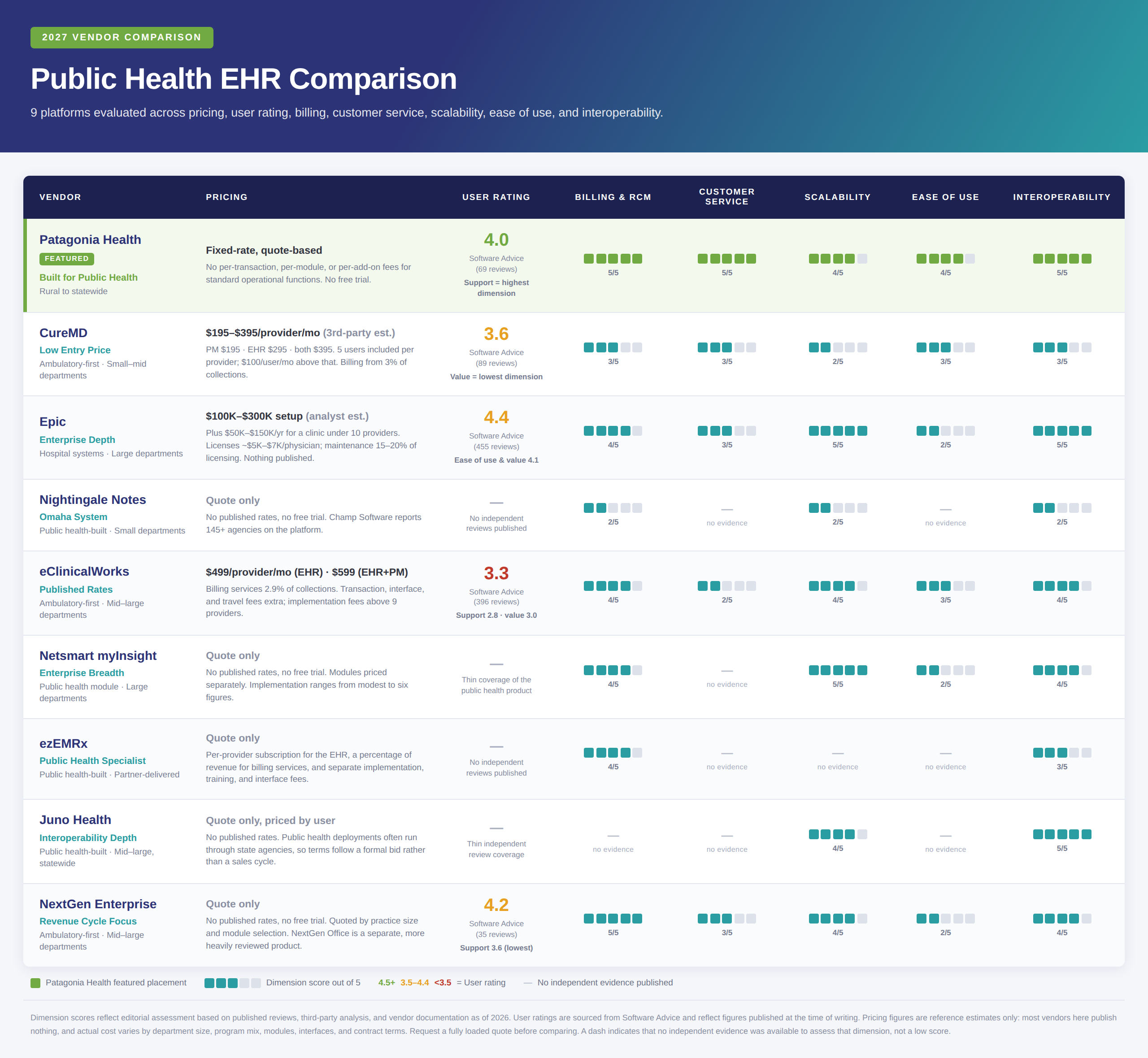
A note on pricing. Public health EHR pricing resists apples-to-apples comparison. Some EHR vendors price per provider, others per user, and others by module or annual contract. A few publish rates. Most require a sales call, and several publish nothing verifiable anywhere. Where figures appear below, they come from vendor websites or third-party comparison sites. Treat all of them as estimates and request a fully loaded quote before comparing. Review scores and counts reflect the figures published at the time of writing and move as clients add new reviews.

CureMD: Broad Specialty Coverage at a Low Entry Price
CureMD is a cloud-based EHR that markets specialty-specific editions across more than 30 clinical specialties, including public health, behavioral health, oncology, pediatrics, and primary care. The company also markets a public sector solution aimed at regulated agencies. Their U.S. headquarters are based in New York, New York, but the majority of their team is offshore in Lahore, Pakistan.
CureMD Pricing
Third-party comparison sites list Practice Management at $195 per provider per month, EHR at $295, and the combined package at $395. CureMD's own pricing page publishes no per-provider figures. It advertises billing services at "as low as 3%" of collections and routes everything else to a quote form, so treat the per-provider numbers as third-party estimates rather than quoted rates.
CureMD charges per provider rather than per user, and its published FAQ states that it allows up to five free users per paying provider, with additional users charged $100 per user per month. For a health department with two or three prescribers supporting a large nursing, billing, front desk, and outreach staff, the number that decides your bill is how many users sit above that allowance.
On Software Advice, CureMD holds 3.6 out of 5 across 89 reviews, scoring between 3 and 4 on ease of use, value, customer support, and functionality. Value for money is the weakest of the four.
Who CureMD Fits Best
- Independent oncology practices and cancer centers
- Small to midsize multi-specialty ambulatory groups
- Private specialty practices in cardiology, dermatology, and internal medicine
- Practices outsourcing revenue cycle management to their EHR vendor
- Health departments where entry price is the binding constraint
Where CureMD May Fall Short
A low entry price is a real advantage for a department working against a tight budget. It is still worth asking what that price reflects. Reviewers rate value for money as CureMD's weakest dimension, which points toward a lighter feature set rather than a discount on a deep one.
Public health also sits among dozens of specialties here, so public health program workflows are more likely to be configured during implementation than delivered at go-live. That shifts cost and time into the project and leaves ongoing maintenance with your team.
It is also worth verifying what type of customer service they offer. With most of their team in Pakistan, it is worth examining whether your team will be routed to an individual or to a large offshore call center.
What to Verify With CureMD
- Your fully loaded cost at your actual staffing ratio, counting every user above the five-per-provider allowance
- Which state registry and laboratory interfaces already exist for your state, what a new build costs, and who maintains it
- Sliding fee scales, grant-tied program codes, and encounter-level grant reporting
- Which reports ship as standard versus requiring custom development
- Where support staff are located, and whether their published response and resolution targets are contractual commitments or internal goals
- Training included by role, and support responsiveness after go-live
- References confirming that their implementation speed matches what is advertised

Epic: Enterprise Depth Built for Large Health Systems
Epic is among the most widely deployed EHR platforms in the country, built primarily for large hospital systems, academic medical centers, and integrated delivery networks. Epic states that the majority of U.S. News and World Report's top-ranked hospitals and medical schools use its software.
Epic Pricing
Epic does not publish pricing, and every contract is negotiated individually. Third-party analysts estimate setup at $100,000 to $300,000 for a small clinic with fewer than 10 providers, plus $50,000 to $150,000 annually, with large systems paying far more.
The same analyses put physician licenses at roughly $5,000 to $7,000 per user, other clinical staff at $3,000 to $5,000 per user, and read-only access at $500 to $1,000 per user, with annual maintenance at around 15 to 20 percent of licensing.
Many health systems running Epic employ dedicated, Epic-certified analysts to administer and optimize the system after go-live. Expect to budget for a decade of operation rather than a signing figure.
On Software Advice, EpicCare holds 4.4 out of 5 across 455 reviews. Functionality scores highest at 4.4, while ease of use and value for money tie for lowest at 4.1.
Who Epic Fits Best
- Large hospital systems and academic medical centers
- Integrated delivery networks spanning inpatient and outpatient care
- Multi-hospital systems standardizing on a single patient record
- Health systems with dedicated, Epic-certified IT staff
- Health departments already operating inside a larger health system's Epic instance
Where Epic May Fall Short
Epic is capable software, and its reviews reflect that. The open question is whether a platform designed for hospital systems will fit with a local health department. Epic's depth and patient data exchange infrastructure can justify the investment for health systems with massive budgets and dedicated IT staff. A department that needs simple workflows and predictable pricing will find both the cost and the implementation load hard to absorb.
What to Verify With Epic
- Total cost of ownership across licensing, implementation, hosting, and training
- Internal IT capacity, including certified staff and ongoing system administration
- Implementation timeline and the staffing it demands through go-live
- Which categorical program workflows exist today and which need configuration
- Annual maintenance, optimization, and upgrade costs after go-live

Nightingale Notes: Omaha System Documentation for Community Health Nursing
Champ Software builds Nightingale Notes, a cloud-based EHR developed specifically for public health departments and community health agencies. The platform is organized around the Omaha System, a standardized taxonomy for community and public health nursing documentation. Champ Software reports more than 145 agencies on the platform.
Nightingale Notes Pricing
Nightingale Notes does not publish pricing. Third-party listings show it as quote-only, with no free trial. It also carries almost no presence on independent software review sites, which is unusual among the platforms here.
Who Nightingale Notes Fits Best
- Departments already using the Omaha System taxonomy
- Small departments with a limited number of users
- Home visiting and community health nursing programs, where documentation sits largely outside of clinic-based billing
Where Nightingale Notes May Fall Short
Scale and scope are the questions. Champ Software is a smaller vendor than most on this list, and its strengths sit in community health nursing rather than high-volume clinic billing. Departments managing several health programs, heavy claims volume, or growth across locations should confirm the platform scales with them before signing.
Certification is worth confirming directly. If your state ties program reporting, HIE participation, or grant eligibility to certified health IT, ask Champ Software for its current CHPL listing and whether it covers a complete EHR or specific modules.
What to Verify With Nightingale Notes
- Current ONC certification status. Ask for the CHPL listing ID directly, and confirm whether it covers the complete EHR or only certain certified modules
- The largest active deployment by user count and program complexity
- Billing workflow specifics, including clearinghouse connection and claims volume
- Immunization registry and Health Information Exchange connection method for your state
- Independent references beyond vendor-published testimonials

eClinicalWorks: Published Rates and Large-Scale Ambulatory Reach
Founded in 1999, eClinicalWorks is among the largest ambulatory EHR vendors in the country, reporting more than 180,000 physicians and 850,000 medical professionals on its software. Its named markets are ambulatory: primary care, urgent care, ambulatory surgery, dental, and eye care.
eClinicalWorks Pricing
eClinicalWorks is one of the few vendors here that publishes rates. Its published pricing page lists EHR only at $499 per provider per month, EHR with Practice Management at $599, and revenue cycle management at 2.9 percent of collections, each marked with no start-up costs.
The footnotes matter. Initial training is included for practices with one to nine providers, and implementation fees apply above that. Travel is billed separately, as are per-transaction fees for patient statements and messenger activity. Reviewers describe additional per-item charges for interfaces, virtual visits, and clearinghouse connections that the base rate does not show.
On Software Advice, eClinicalWorks holds 3.3 out of 5 across 396 reviews, with customer support the lowest dimension at 2.8 and value for money at 3.0.
Who eClinicalWorks Fits Best
- Independent primary care and multi-specialty practices
- Urgent care centers and ambulatory surgery centers
- Dental and eye care practices
- Practices outsourcing revenue cycle management at a percentage of collections
- Growing practices that want published rates and a largely remote implementation
Where eClinicalWorks May Fall Short
Public health is not a vertical eClinicalWorks builds for. Public Health programs, sliding fee scales, grant-tied funding codes, and state registry connections would arrive as configuration work.
Reporting deserves a hard look. Reviewers repeatedly describe clinical reporting and data extraction as difficult. Grant deliverables, state submissions, and program performance all run through that function. eClinicalWorks also carries the lowest customer support score in this comparison. When a report does not produce what you need, you wait on a ticket. Grant deadlines do not wait with you.
What to Verify With eClinicalWorks
- Fully loaded cost, including transaction fees, interfaces, and implementation above nine providers
- Which public health program workflows would be built for you, by whom, and on what timeline
- Whether your grant, state, and program reports can be produced without custom development
- Support escalation path and documented ticket resolution times
- State registry and Health Information Exchange connection method and cost

Netsmart myInsight: Enterprise Reach Across Public Health and Human Services
Netsmart is one of the largest health and human services software vendors in the country, spanning behavioral health, post-acute care, human services, and public health across its CareFabric platform. Its public health product, myInsight, covers immunizations, family planning, STI, tuberculosis, and maternal and child health, with automated support for Title V and Title X reporting.
Netsmart Pricing
Netsmart does not publish pricing and offers no free trial. Contracts are quote-based and scale with department size, program mix, and modules selected. Third-party estimates vary widely and do not agree with one another, so treat any figure you find online as a rough signal.
Implementation is where enterprise platforms separate from lighter ones. Costs range from modest for a small configuration into six figures for a large multi-program deployment, and because modules are priced separately, your true cost may differ substantially from base pricing. Ask for a loaded scenario covering modules, interfaces, implementation, and training before comparing Netsmart to a flat-rate platform.
Independent review coverage of the public health product is thin compared to Netsmart's behavioral health line, so references from departments that resemble yours in size and program mix carry more weight here than a score.
Who Netsmart Fits Best
- Large county and metro health departments with complex program portfolios
- Departments consolidating public health, behavioral health, and human services under one vendor
- Multi-site departments with enterprise reporting requirements
- Departments with internal IT capacity for ongoing configuration and administration
Where Netsmart May Fall Short
Breadth is the case for an enterprise platform, and Netsmart's breadth is real. The tradeoff is weight. A system with capacity for everything asks more of the people running it, and software your staff cannot navigate does not improve reporting or care.
What to Verify With Netsmart
- Implementation scope and a realistic timeline for a department your size
- Training requirements across clinical, billing, program, and administrative roles
- Internal IT capacity needed for ongoing configuration and administration
- Support responsiveness during operational disruptions
- How grant, state, and federal reporting is built and maintained across programs
ezEMRx: A Public Health Specialist Delivered Through a Partner Model
ezEMRx is one of the few EHRs in this comparison built exclusively for public health. It reaches departments through a two-company arrangement: CDP Inc. handles delivery, implementation, and support, while ezEMRx, Inc. develops the software. CDP has focused on public health software for more than 40 years.
CDP Pricing
CDP does not publish rates. Its price transparency statement describes the model rather than the numbers: a per-provider subscription for the EHR, a percentage of revenue for revenue cycle management, and separate fees for implementation, training, and interfaces.
Who ezEMRx Fits Best
- Departments running environmental health inspections that want the clinical record from the same provider
- Departments administering WIC benefits alongside clinical services
- Departments whose most pressing problem is claims and reimbursement performance
Where ezEMRx May Fall Short
Outside evidence is the gap. ezEMRx carries essentially no independent reviews on any major software review site, so there is no third-party record to weigh against the sales conversation. References from comparable departments matter more here than anywhere else on this list. Note also that RCM is an optional component rather than included scope, which affects how you compare the quote.
What to Verify With ezEMRx
- Current ONC certification edition and criteria, confirmed on the public Certified Health IT Product List
- Release cadence, and specifically what has shipped in the past two years
- Whether the reporting you need is standard or requires an analytics add-on, and what that adds
- Whether registry, WIC, and Health Information Exchange integrations work in your state
- How enhancement requests get prioritized, given that CDP delivers the software and ezEMRx develops it
- References from departments of similar size and program mix
Juno Health: Interoperability Depth Aimed at Statewide Deployments
Juno Health is a division of Document Storage Systems, Inc. (DSS, Inc.), a company serving federal, acute care, and government health markets. Juno builds EHRs for acute care, public health, state mental health, critical access, and inpatient behavioral health settings under the tagline "built by clinicians, for clinicians."
Juno Health Pricing
Juno Health does not publish pricing. Contracts are quote-based and priced by user. Third-party estimates exist but disclose no methodology and should not be read as rates.
Because Juno's public health deployments tend to run through state agencies, procurement often follows a formal bid process rather than a sales cycle. Terms available to a single county health department can look very different from a statewide award.
Who Juno Health Fits Best
- Mid-to-large health departments with internal IT and configuration capacity
- Health systems running acute care and public health under one vendor
- Departments prioritizing electronic case reporting and syndromic surveillance connections
Where Juno Health May Fall Short
Scale is the honest caveat. Juno's interoperability depth can justify itself for mid-to-large departments with the internal capacity to configure and maintain it, while smaller departments should confirm they are not buying enterprise scale they will never use. Independent reviews are thin, so outside references carry the weight a review score would carry elsewhere.
What to Verify With Juno Health
- Whether the deployment model fits a single department or assumes a statewide rollout
- Which interfaces are already built for your state
- Configuration ownership, and how much your team can change without vendor involvement
- Support structure, including whether Juno Health and DSS are separate escalation paths
- Pricing model and total cost at your user count, in writing
- References from departments of comparable size, not only statewide agencies
- Direct conversations with those references, rather than vendor-authored case studies or a logo wall.
- Whether named customers are full implementations or short projects, and still live today
NextGen Healthcare: Ambulatory Enterprise Platform Built Around Revenue Cycle
Founded in 1974, NextGen Healthcare serves ambulatory medicine and describes itself as reimagining ambulatory healthcare. Its named markets are primary care, specialty practices, community health centers, behavioral health, and dental.
NextGen Pricing
NextGen does not publish pricing and offers no free trial. Contracts are quoted by practice size and module selection. Request a fully loaded quote covering modules, interfaces, implementation, and training.
On Software Advice, NextGen Enterprise holds 4.2 out of 5 across 35 reviews, with customer support the lowest dimension at 3.6. NextGen Office, the small-practice product, is reviewed far more heavily and is a different system, so check which product a given score describes.
Who NextGen Fits Best
- Medium to large ambulatory practices and multi-specialty groups
- Practices where revenue cycle performance is the deciding factor
- Practices adopting ambient documentation and AI-assisted coding
Where NextGen May Fall Short
Public health is not among the markets NextGen builds for. Its design center is the ambulatory encounter, which leaves public health programs as configuration work.
Reviewers also point to a steep learning curve, navigation spread across multiple sub-screens, and reporting limitations. Support is the weakest-scoring dimension on the enterprise product. For a department whose grant and state reporting cannot slip, both deserve scrutiny before signing.
What to Verify With NextGen
- Which public health program workflows exist today versus what’s configured at implementation
- Whether grant, state, and program reporting can be built without custom development
- Support responsiveness, escalation path, and time to an assigned account contact
- Fully loaded cost, including modules, interfaces, and implementation
- Data ownership and export rights at contract end

Patagonia Health: Configurable Program Workflows for Health Departments
Patagonia Health is an integrated EHR, Practice Management, and Billing solution built specifically for local health departments, from small rural departments to statewide systems. The platform aligns clinical documentation, scheduling, billing, reporting, and administrative workflows, and adapts to the categorical programs that separate public health from ambulatory care.
That adaptability matters because a health department runs several programs out of one building, and each one documents differently. A WIC visit needs different forms than a family planning visit.
The Custom Forms App supports that range. Health departments can build and publish customized electronic forms for specific programs in real time, and those forms integrate directly into the EHR through a centralized dashboard, so staff are not completing documentation outside the system and attaching it manually.
How Patagonia Health Prices Its EHR
Patagonia Health uses a fixed-rate model with no per-transaction, per-module, or per-add-on charges for standard operational functions. Pricing is quote-based and scales with department size and deployment scope. There is no free trial.
That structure matters most where budgets are tightest. A department working from grant cycles and county appropriations needs to know what a system costs in year three, not only at signing. Against enterprise peers whose modules and interfaces are priced separately, total cost of ownership with fewer variable charges is often more competitive than a starting figure suggests.
On Software Advice, Patagonia Health holds 4.0 out of 5 across 69 reviews, with customer support its highest-rated dimension.
Who Patagonia Health Fits Best
- Small and rural local health departments managing several programs with limited staff
- County and metro health departments running multiple service lines under one system
- Multi-county consortiums purchasing and implementing together under shared grant funding
- Statewide systems standardizing county health departments on a single record
- Departments delivering care in the field, at mobile clinics, and in school-based settings
- Departments needing tighter alignment between clinical documentation, billing, and grant reporting
The value shows up differently by role. Public health nurses get configurable forms that capture what each program requires without pushing documentation outside the EHR. Billers get documentation that connects directly to claims, shortening the path from service to reimbursement. Program managers get encounter data and grant-tied codes feeding reporting without a separate spreadsheet. Directors get visibility into program performance and revenue across locations.
Release Cadence, Certification, and Roadmap Access
EHR ownership continues long after go-live. State reporting requirements change, registry specifications get updated, and payer rules shift. A platform that cannot keep pace becomes a liability.
Patagonia Health is ONC-certified Health IT, certified by an ONC-Authorized Certification Body and listed on the public Certified Health IT Product List. That certification supports departments pursuing Promoting Interoperability requirements.
New releases ship every six weeks, so fixes and enhancements reach departments in weeks rather than waiting on an annual upgrade cycle, and regulatory and reporting changes can be absorbed as they arrive.
Departments also have a direct line into what gets built. Through the Ideas Portal, staff submit feature requests from inside the EHR, check whether a similar idea already exists, vote, comment, and track status through planned and shipped. Requests route to the product management team, and shipped items appear in release notes, so staff can influence the roadmap directly instead of passing suggestions through an account manager.
What Support Looks Like After Go-Live
Your EHR stays part of your workflow long after implementation. When state requirements change or when something in the system is not working, you need a partner who will work through it with you.
Here is what a department can expect from Patagonia Health after go-live:
- A transition to support on the department's timeline. The handoff from the implementation team happens when the department says it is ready, not automatically at go-live.
- A support team based in Cary, North Carolina. Email, ticket, or phone, with no routing to a generic call center.
- Help from people who know public health billing. Not every local health department has a professional coder on staff. The support team works through coding and claims questions rather than pointing back to documentation.
- Patagonia Health Academy, available as an add-on. Turnover is constant in public health. Role-based learning paths mean a nurse hired next spring can take the track she needs without relying on existing staff to train on the system.
- In-person User Group events. Patagonia Health hosts User Groups in select locations, with hands-on training, sessions on new features, and targeted billing training. Staff compare workflows with other health departments in their state, and feedback from the room feeds back into the product.
Customer support is Patagonia Health's highest-rated dimension on Software Advice. In a market where support responsiveness is the common complaint about nearly every vendor, that is a dimension worth weighing.

Ten Questions to Ask Before You Sign an EHR Contract
Feature lists do not surface the operational questions that decide whether an implementation goes well. Push for direct answers to these:
- Which of our programs are supported the day we go live, and which forms would your team need to build for us?
- What does implementation look like for a department our size, and what will it require from our staff?
- Who gets trained, on what, and what does it cost to train someone we hire two years from now?
- When we call for help, who answers, and what do your current customers say about that experience?
- Which reports come out of the box, and which require custom configuration?
- What does our cost look like in year three if we add users, programs, or another location?
- How do you protect confidentiality for sensitive services like STI treatment, HIV care, and family planning, in the chart, in the patient portal, and in anything mailed to a patient's home?
- When our state changes a reporting requirement or a registry specification, is that an included update or a billable change request?
- What do departments like ours tell you got harder after switching?
- Which health departments around our size can we call for a reference?
For a structured approach to the full selection process, download our EHR Vendor Evaluation Kit. It covers how to uncover hidden costs, structure demos around real workflows, and build comparisons that go past feature checklists.
Bring Your Real Constraints to Every Vendor Conversation
No public health EHR fits every health department. Some are enterprise platforms built for hospital systems and statewide deployments. Others are ambulatory products that treat public health as one specialty among dozens. What separates a good decision from a painful one is how honestly you assessed operational fit before signing. Put your real constraints on the table in every demo:
- Staffing. How many people you have, and what they are already carrying.
- Reporting. Which grants and state agencies you answer to, and on what schedule.
- Billing. How reimbursement actually works across your programs and payer mix.
- IT capacity. Who administers and maintains the system after go-live.
- Direction. Where the department expects to be in five years.
This decision shapes clinical workflows, revenue, staff retention, and your ability to answer to funders and to your community for years. A careful comparison moves you past the demo and toward what determines whether the system works: documentation your staff will complete, reporting that arrives on time, and operations your department can sustain.
Frequently Asked Questions
What does a public health EHR comparison evaluate?
A public health EHR comparison evaluates platforms against the work health departments actually do: categorical program documentation, immunizations, communicable disease, family planning, maternal and child health, sliding fee scales, billing and claims, grant and state reporting, registry and lab interfaces, care coordination, and field-based care.
What makes a public health EHR different from a standard EHR?
A public health EHR is built around categorical programs and population health rather than the fee-for-service encounters a private practice or hospital bills for. It supports immunization registry reporting, communicable disease investigation, family planning, and other common public health programs without requiring custom configuration and development.
Which EHR is best for a health department?
There is no universal answer. The right EHR for your health department depends on its size, program mix, billing complexity, reporting obligations, IT capacity, and budget cycle. A rural department covering six programs with twelve staff needs something different from a metro department running clinics across nine locations.
How much does a public health EHR cost?
The cost of a public health EHR depends on how a vendor structures pricing, as well as the size of your health department. Common models include per user per month, per provider per month, per module or feature set, per site, and flat enterprise licensing, and some vendors bill per encounter. Implementation, data migration, and training are usually priced separately from the license. Ask every vendor which model they use, what counts as a billable user, what falls outside the base price, and what total cost of ownership looks like across the full contract term rather than year one.
What should health departments prioritize during EHR selection?
During the selection process, public health departments should prioritize EHRs with documentation your clinical staff will actually complete, billing that connects cleanly to that documentation, reporting that satisfies funders without custom development, working interfaces to your state's registries and labs, accessible patient data across programs, confidentiality controls for sensitive services, support you can reach, and total cost of ownership across the full contract rather than year one.
Which platforms do small and rural health departments usually evaluate?
When choosing an EHR, smaller departments tend to prioritize ease of use, fast implementation, and a price that fits a constrained budget. The public health specialists in this guide, including Patagonia Health, Nightingale Notes, and ezEMRx, are built around that scale. Multi-county consortiums sometimes pool grant funding to purchase and implement together.
Which platforms do large county or statewide departments usually evaluate?
Larger departments typically need an EHR with multi-site consistency, enterprise reporting, deep interoperability, and role-based access across many users. Patagonia Health, Netsmart, and Juno Health are built for that scale, with Epic appearing where a department sits inside a larger health system.
What if some of our staff are not comfortable with new technology?
If your staff isn't comfortable with new technology, ask every vendor how they handle adoption across a wide range of technical comfort. A user-friendly interface carries more weight in public health than in most settings, because nurses, front desk staff, billers, and outreach workers all learn the same health record (EHR) system. Look at how many clicks a routine visit takes, whether staff train in their own database rather than a generic sandbox, and what role-based training exists for someone hired two years from now.