
Key Takeaways
- The best behavioral health EHR fits your care model, billing environment, and operational capacity, not just your feature wishlist.
- Patagonia Health stands out for organizations that need flexible workflows, customizable forms, integrated billing, and consistent documentation governance.
- Netsmart, Qualifacts Credible, TherapyNotes, Ensora Health, SimplePractice, athenahealth, and eClinicalWorks each serve different organizational sizes and priorities.
- AI features require careful evaluation. Accuracy, human oversight, privacy, and compliance matter more than marketing claims.
Behavioral Health EHR Vendor Comparison
The best behavioral health EHR isn't the one with the longest feature list. It's the one that fits your care model, reimbursement requirements, staffing realities, and operational goals.
This comparison evaluates eight platforms through an operational lens, covering how each fits different types of organizations, from solo therapy practices to large community mental health centers.
How We Compared These EHRs
- Pricing and transparency: What does it actually cost, including hidden fees, per-module charges, and per-transaction costs?
- Clinical documentation fit: Does the platform support your documentation workflows, forms, and program types?
- Billing and revenue alignment: How tightly does documentation connect to claims, and how does the platform handle denials, authorizations, and payer complexity?
- Operational scalability: Will this platform support your organization today and where it's headed?
- Implementation and support: What does onboarding look like, and how does the vendor respond when problems arise?
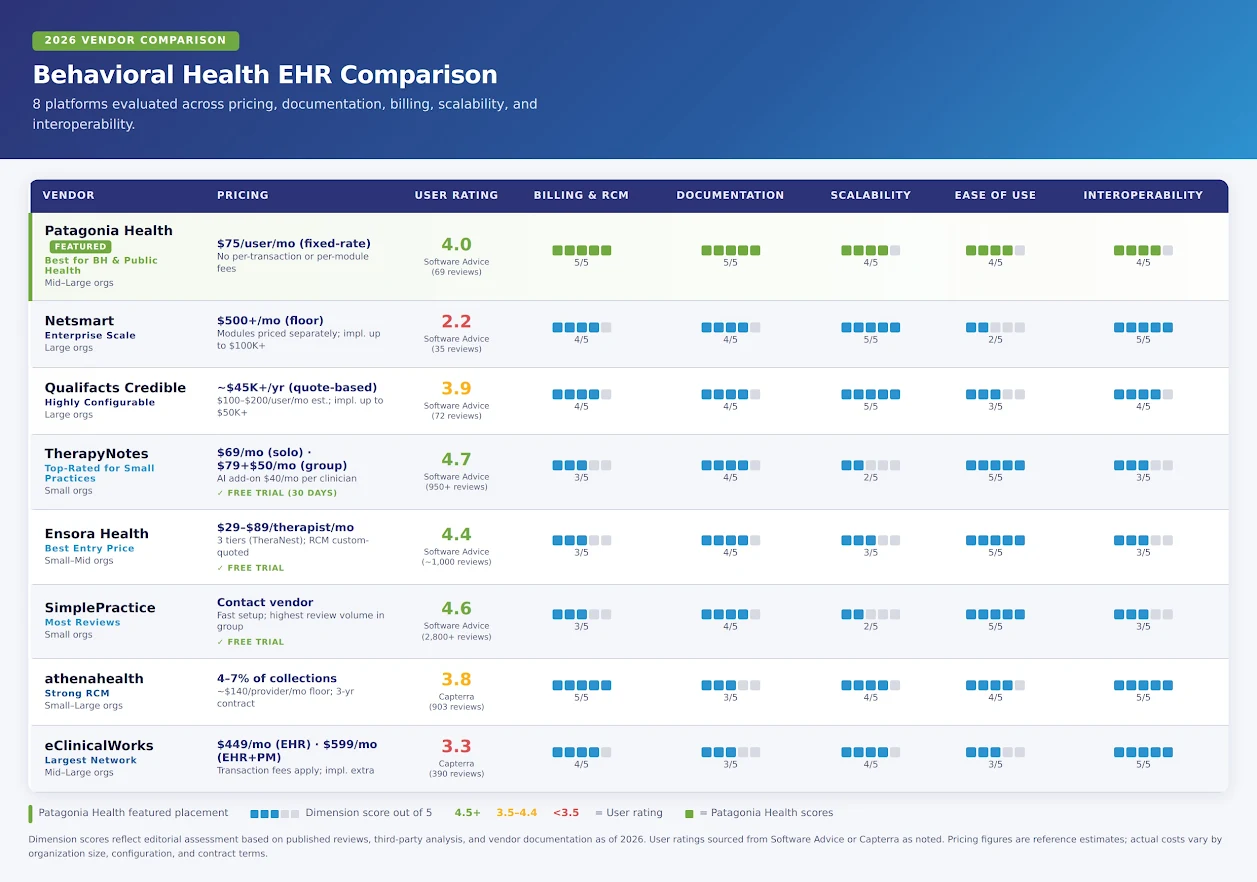 A note on pricing: Behavioral health EHR pricing isn't directly comparable. Some vendors price per therapist per month. Others are priced by organization, module, or annual contract. Some publish rates. Others require a sales call before sharing any number. Pricing data is an estimate based on publicly available software review sites such as Software Advice, Capterra, and G2. Keep that context in mind throughout this comparison.
Netsmart: Enterprise Depth for Complex Behavioral Health Organizations
Netsmart (myAvatar) is one of the largest behavioral health EHR vendors in the US, supporting behavioral health, addiction treatment, child and family services, intellectual and developmental disabilities, and related human services.
Netsmart Pricing
Published starting figures cite roughly $500/month as a floor, but enterprise deployments run substantially higher once modules, implementation, and support are fully loaded. Modules are typically priced separately, so the base cost and fully operational cost can differ significantly. Implementation fees range from $5,000 for smaller configurations to $100,000 or more for large enterprise deployments. Request fully loaded cost scenarios before comparing.
On Software Advice, myAvatar has a 2.2 out of 5 rating based on 35 reviews, with consistently low marks for ease of use and value for money.
Strong fit for:
- Large behavioral health organizations and community mental health centers
- Substance use treatment organizations
- Multi-site agencies with complex enterprise reporting needs
- Programs requiring broad behavioral health and human services coverage
The advantage of an enterprise platform is depth. The tradeoff is complexity. Broad capabilities can still create problems if staff struggle to adopt the system or workflows fragment across departments.
What to evaluate:
- Implementation scope and realistic timeline for your organization
- Training requirements across clinical, billing, and administrative roles
- Internal IT capacity for ongoing administration
- Support responsiveness during operational disruptions
- How reporting is configured and maintained across programs
Netsmart's breadth may be worth the investment for highly complex environments. Midsize organizations seeking streamlined workflows and faster implementation may find the administrative overhead difficult to absorb.
TherapyNotes: Straightforward Practice Management for Smaller Practices
TherapyNotes is a behavioral health EHR and practice management platform built for therapists, counselors, psychologists, psychiatrists, and smaller behavioral health practices.
TherapyNotes Pricing:
Solo practitioners pay $69/month. Group practices pay $79/month for the first clinician, then $50/month per additional provider. The AI documentation add-on (TherapyFuel) runs $40/month per clinician. No setup fees or data migration charges apply to standard onboarding. TherapyNotes raised prices roughly 15 to 17% in late 2025, but remains competitive relative to peers. A 30-day free trial is available.
On Software Advice, TherapyNotes earns 4.7 out of 5 across 950+ reviews, the highest rating in this group.
Strong fit for:
- Solo practitioners and small therapy groups
- Counseling practices transitioning from paper charts
- Therapy startups wanting core practice management without enterprise complexity
Simplicity is a real advantage for smaller practices. The core question is whether the platform scales as the organization grows. Larger organizations may need deeper denial management, secondary payer workflows, authorization tracking, and multi-program reporting.
What to evaluate:
- Whether billing workflows can support growing payer complexity
- How denied claims are managed and tracked
- Whether secondary payer workflows fit your payer mix
- Whether reporting meets leadership and compliance requirements

Credible by Qualifacts: Configurable Infrastructure for Large Agencies
Credible, operated by Qualifacts, serves large behavioral health agencies, including community mental health centers, CCBHCs, substance use disorder programs, IDD services, residential programs, and integrated primary care.
Credible Qualifacts Pricing
Credible is among the higher-cost platforms in this group. Published analysis puts starting costs at approximately $45,000 annually on a quote-based model. Per-user estimates from third-party sources suggest $100 to $200/user/month for smaller organizations, scaling down as headcount grows. Implementation costs range from $5,000 to $50,000 or more. All pricing requires direct engagement with a Qualifacts sales team. Budget conservatively and ask specifically about implementation, training, administration, and add-on module costs.
On Software Advice, Credible holds 3.9 out of 5 across 72 reviews.
Strong fit for:
- Large agencies with complex program structures and varied payer requirements
- Multi-location organizations that need broad configurability
- Human services organizations with internal capacity to manage ongoing system administration
Configurability is the primary advantage. For large agencies managing varied programs and payers, a configurable EHR can align to operational needs rather than forcing operations to conform to the software. The risk is that poorly governed configurability creates documentation inconsistencies, unreliable reporting, and harder upgrades. Be clear about who owns the system post go-live and what governance looks like on an ongoing basis.
What to evaluate:
- Who owns system configuration after implementation, and what that role requires
- How workflow changes are reviewed and approved across programs
- Whether reporting stays consistent across locations and service lines
- Internal IT and administrative resources required to run the platform
- Support responsiveness during downtime or performance issues

Ensora Health: Therapist-Centered Workflows With Telehealth Focus
Ensora Health builds EHR and practice management software for mental, behavioral, and rehabilitative therapy practices, with an emphasis on therapist-oriented workflows, telehealth, scheduling, messaging, payment processing, and mobile access.
Ensora Health Pricing
Ensora's core platform (TheraNest) offers three tiers: Essentials at $29/therapist/month, Advanced at approximately $49/therapist/month (adds insurance billing and telehealth), and Premier at $89/therapist/month (adds AI documentation tools and Wiley Practice Planners). Additional admin users run $19 to $29/month by tier. Ensora RCM is custom-quoted separately. Ensora carries the lowest published entry price in this group, though the Premier tier narrows that gap for practices wanting full functionality. A free trial is available.
On Software Advice, Ensora holds 4.4 out of 5 across nearly 1,000 reviews.
Strong fit for:
- Therapist-centered practices and smaller behavioral health organizations
- Counseling groups prioritizing telehealth and client convenience
- Teams that want approachable workflows and digital engagement tools
For therapy-focused organizations, ease of use and client communication tools may matter more than enterprise reporting or complex billing infrastructure. As operational complexity grows, however, practices with advanced billing, reporting, interoperability, or care coordination requirements should test whether the platform can keep up.
What to evaluate:
- How billing handles payer complexity across multiple payer types
- Telehealth and secure messaging reliability
- Whether reporting meets leadership and compliance needs
- Whether the system supports growth across more programs, providers, or locations

SimplePractice: Fast Onboarding for Solo and Small Group Practices
SimplePractice is a widely used EHR and practice management platform built for therapists and health and wellness professionals, centered on fast setup and ease of use.
On Software Advice, SimplePractice earns 4.6 out of 5 across 2,800+ reviews, the highest review volume in this comparison by a wide margin.
Strong fit for:
- Solo therapists and small group practices
- Wellness providers and new behavioral health practices
- Organizations prioritizing fast onboarding, scheduling, documentation, billing, and client communication
For very small organizations, fast onboarding is a genuine advantage. A clean calendar, progress notes, claims tools, telehealth, forms, and a client portal may be enough. As practices grow, more providers, payers, service types, and locations create workflow demands that simpler platforms weren't built to handle.
What to evaluate:
- Whether the platform supports the operational scale you're moving toward
- How billing handles more complex reimbursement needs
- Whether reporting is sufficient for leadership decisions and compliance oversight
- Whether role-based workflows are adequate for larger teams

Athenahealth: Strong RCM Infrastructure, Limited Behavioral Health Depth
Athenahealth is one of the most widely deployed EHR platforms in the US. Its cloud-native product, athenaOne, integrates EHR, revenue cycle management, and patient engagement in a single environment. athenaOne is rated the best KLAS overall solution for independent physician practices and earns consistent marks for its RCM infrastructure and interoperability. The key caveat for behavioral health: athenahealth is a general ambulatory EHR, not a behavioral health platform. Practices needing treatment plan tracking, group therapy documentation, or SUD-specific billing workflows should evaluate dedicated behavioral health EHR systems.
AthenaHealth Pricing:
athenahealth doesn't publish fixed pricing. Most contracts are structured as a percentage of collections, typically ranging from 4 to 7% depending on practice volume and negotiated terms. athenaOne pricing typically starts around $140/provider/month and may range between 4% and 8% of a practice's total monthly collections.
The percentage model has meaningful cost implications at scale. A 5-provider group collecting $2.5M annually pays roughly $125,000/year, which is materially more than flat-rate competitors. athenahealth requires a 3-year initial contract, and early termination fees are calculated by multiplying average monthly charges by the number of months remaining. Model your volume carefully before committing.
On Capterra, athenaOne holds a 3.8 out of 5 across 903 reviews.
Strong fit for:
- Small to midsize primary care, pediatrics, and multi-specialty practices
- Organizations wanting a strong RCM infrastructure and network-driven claims support
- Practices prioritizing interoperability and patient engagement
- Organizations where a percentage-of-collections model aligns with the growth stage
Where it may fall short for behavioral health
Customization options are primarily limited to templates, workflows, and report generation, which can restrict adaptability for unique practice needs. For behavioral health organizations managing specialized documentation, group therapy, SUD programs, or public health reporting, that matters.
What to evaluate:
- Whether the percentage-of-collections model is cost-effective at your revenue volume
- How the platform handles behavioral health documentation, including treatment plans, group notes, and SUD workflows
- What behavioral health templates exist out of the box versus what requires custom build
- Contract length, termination terms, and data export rights

eClinicalWorks: Broad Ambulatory EHR With Behavioral Health Modules
eClinicalWorks is one of the largest ambulatory EHR vendors in the US, serving over 180,000 physicians and 850,000 healthcare professionals globally. Its cloud-based, AI-assisted platform includes dedicated behavioral health modules covering outpatient therapy, inpatient psychiatric care, substance use disorder programs, CCBHCs, and integrated care settings.
eClinicalWorks supports therapy and skills training for substance use disorders and co-occurring mental health conditions, outpatient counseling and psychiatry, and confidential note options visible only to providers and supervisors. Behavioral health is a named vertical, but reviewer feedback consistently notes that realizing that functionality requires significant configuration.
eClinicalWorks Pricing
eClinicalWorks starts at $449/user/month for EHR only, and $599/month per provider for EHR with Practice Management, with no stated startup costs for standard configurations. The base pricing is competitive, but the total cost expands. Transaction-based fees apply per patient statement and per eClinicalMessenger message. Implementation services typically run $1,500 to $3,500 per provider, with data migration adding $500 to $1,500 per provider. Additional fees can include charges per virtual visit, iPad usage, clearinghouse fees, annual ECPS fees, and integrated scribe fees. Always request a fully loaded cost scenario before comparing to flat-rate platforms.
On Capterra, eClinicalWorks holds a 3.3 out of 5 across 390 reviews, with customer service rated 2.8, the lowest dimension score.
Strong fit for:
- FQHCs and community health centers managing behavioral and primary care together
- Multi-specialty organizations integrating behavioral health into broader ambulatory workflows
- CCBHCs and programs requiring population health management tools
- Organizations prioritizing interoperability and a large vendor ecosystem
Where it may fall short
The system has a steep learning curve and can feel overwhelming at first. Some workflows are not intuitive, and reporting and data extraction can be limited without advanced configuration. Support responsiveness is a recurring complaint. For organizations that need tight documentation governance and reliable support during operational issues, those patterns deserve close scrutiny before signing.
What to evaluate:
- How behavioral health workflows are configured out of the box versus what requires custom development
- Total cost of ownership, including all transaction-based fees, implementation, and add-ons
- Support responsiveness and escalation processes
- Whether documentation stays consistent across behavioral health and primary care service lines

Patagonia Health: Adaptable Workflows Built for Behavioral and Public Health
Patagonia Health is an integrated EHR, practice management, and billing solution built specifically for behavioral and public health organizations. The platform aligns clinical documentation, scheduling, billing, reporting, and administrative workflows, and adapts to specialized programs across diverse operational environments.
That adaptability matters for organizations that manage multiple service lines under a single system. A substance use treatment program needs different forms than an outpatient therapy program. A medication management workflow requires different documentation than a case management workflow. A behavioral health organization affiliated with a local health department may need workflows that support both direct clinical care and public health reporting.
Patagonia Health's Custom Forms App supports this range. Organizations can build and publish customized electronic forms for specific programs, including case management and medication management, in real time. Forms integrate directly into the EHR via a centralized dashboard, so staff don't have to complete documentation outside the system and manually attach it.
Patagonia Health Pricing
Patagonia Health uses a fixed-rate pricing model with no per-transaction, per-module, or per-add-on charges for standard operational functions. Pricing is quote-based and scales with organizational size and deployment scope. Published figures cite a starting point around $75/user/month, though actual costs vary by users, service lines, and implementation scope. No free trial is offered. For organizations comparing Patagonia Health against enterprise peers like Netsmart and Qualifacts Credible, the total cost of ownership with fewer surprise fees is often more competitive than the starting figure suggests.
On Software Advice, Patagonia Health holds 4.0 out of 5 across 69 reviews, with customer support as its highest-rated dimension.
Strong fit for:
- Midsize and larger outpatient mental health clinics
- Substance use treatment centers
- Behavioral health programs connected to local or state health departments
- Organizations managing multiple service lines under one platform
- Teams seeking tighter alignment between clinical documentation, billing, and reporting
For clinical staff, flexible forms capture the right information for each service without pushing work outside the EHR. For billers, documentation-to-claims alignment creates a cleaner path from service to reimbursement. For administrators and leadership, integrated workflows reduce manual workarounds and provide visibility into program performance and reimbursement trends.
On AI, Patagonia Health takes a supporting role approach. The core value is adaptable workflows, billing alignment, and documentation consistency. AI, when present, supports those goals rather than replacing them.
Evaluating AI Features in Behavioral Health EHRs
AI is one of the dominant marketing themes in behavioral health EHR comparisons right now. Vendors promote AI-assisted documentation, automated scheduling, chatbot support, predictive analytics, coding suggestions, and workflow automation.
AI can provide real value. But it deserves careful evaluation before adoption. A documentation drafting tool may shift the burden to review rather than eliminate it. Automated recommendations should support, not replace, clinical judgment.
Questions to ask any vendor:
- How is AI-generated documentation reviewed and approved?
- What human oversight is built into the workflow?
- Does the AI feature actually reduce workload, or does it shift the burden to review?
- What data is used to train AI tools, and do clients consent to that use?
- Can staff disable AI features when they're not clinically appropriate?
- How does the system support compliance and audit readiness when AI is involved?
Interoperability: Connecting Care Across Providers and Systems
Behavioral health care is often one part of a broader whole-person care picture. Clients frequently receive services from multiple providers, and care teams need timely, accurate information without creating privacy risks.
Questions to evaluate interoperability:
- What interoperability standards does the vendor support?
- Can the EHR connect with pharmacies, labs, health information exchanges, payers, and referral partners?
- How does the system manage consent and handle sensitive behavioral health information?
- Are audit logs accessible and easy to review?
- How are integrations monitored and maintained after go-live?
- What support is available when an integration fails?
Billing Integration: Connecting Documentation to Reimbursement
Behavioral health billing is complex. Organizations often manage Medicaid, commercial payers, secondary insurance, authorizations, grants, funding codes, service limits, claims edits, and payer-specific documentation requirements simultaneously.
When billing doesn't align with documentation, problems compound. Billers chase missing progress notes. Clinicians revise documentation after services are already queued. Administrators can't see denial patterns. Leadership misses revenue cycle problems until they've hit cash flow.
Key billing considerations:
- Claims creation and submission workflows
- Denial management tools and reporting
- Authorization tracking and secondary payer workflows
- Billing code and funding code support
- Charge review and payment posting
- Aging claims visibility and audit-ready documentation linkage
Questions to Ask Before Signing an EHR Contract
Feature lists don't surface the operational questions that matter most. Before signing, push for direct answers to:
- How difficult is implementation for an organization of our size and complexity?
- What training is included for clinicians, billers, administrators, and IT staff?
- How does support respond during outages or workflow disruptions?
- What reporting is included without custom development or added cost?
- How does pricing scale as users, programs, or locations grow?
- What operational pain points does this EHR reduce for organizations like ours?
- How does the platform handle consent, privacy, security, and role-based access?
- What happens when payer requirements change?
- Can the vendor provide references from organizations with similar workflows and complexity?
For a structured approach to the full selection process, download our EHR Vendor Evaluation Kit. It covers how to uncover hidden costs, structure demos around real workflows, and build comparisons that go beyond feature checklists.
Choosing an EHR That Supports the Work, Not Just the Demo
No behavioral health EHR fits every organization. Some excel at enterprise configurability. Others prioritize ease of use, telehealth, or therapist-centered simplicity. Some invest heavily in AI. Others focus on flexible workflows, billing alignment, and documentation consistency.
What separates a good EHR decision from a difficult one is how thoroughly you evaluated operational fit before signing. Bring staffing realities, reimbursement complexity, reporting requirements, implementation capacity, and long-term scalability to every vendor conversation. A behavioral health EHR shapes clinical workflows, billing operations, staff satisfaction, and organizational sustainability for years.
Seek feedback not just from your clinicians, but from everyone who touches the system. A workflow that looks smooth to leadership in a demo may add steps for the clinician writing progress notes or the biller tracking down a missing signature. Include a representative for each role in demos, and ask to see a walk-through of tasks they handle every day.
A careful behavioral health EHR vendor comparison helps you move past the demo and focus on what matters most: reliable documentation, accurate reimbursement, coordinated care, and sustainable operations for the communities you serve.
FAQ
What is a behavioral health EHR vendor comparison?
A behavioral health EHR vendor comparison evaluates EHR platforms on how well they support behavioral health workflows, including documentation, treatment plans, billing, claims management, reporting, interoperability, telehealth, client engagement, privacy, and scalability.
What is the best behavioral health EHR?
There's no universal answer. The best platform depends on organizational size, workflow complexity, billing needs, reporting requirements, IT capacity, and operational priorities. Smaller practices often prioritize ease of use and quick onboarding. Larger organizations typically need deeper billing, reporting, interoperability, and multi-program workflow support.
Are AI-powered behavioral health EHRs worth it?
AI tools may reduce documentation burden and improve workflow efficiency, but organizations should evaluate accuracy, human oversight, privacy, security, compliance, and whether AI actually reduces staff workload or just shifts it.
Which behavioral health EHR is best for small practices?
Smaller therapy practices often prioritize affordability, fast setup, telehealth, and ease of use. TherapyNotes, Ensora Health, and SimplePractice frequently appear in comparisons for smaller or therapist-centered workflows.
Which behavioral health EHR is best for larger organizations?
Larger organizations typically need robust billing workflows, enterprise reporting, interoperability, role-based access, and multi-program support. Patagonia Health, Netsmart, and Qualifacts Credible are commonly evaluated by organizations with complex operational needs.
What should behavioral health organizations prioritize during EHR selection?
Prioritize documentation usability, billing integration, denial management, reporting, interoperability, support responsiveness, implementation resources, privacy controls, scalability, and fit with real-world workflows.
What should substance use disorder (SUD) treatment programs look for in an EHR?
SUD programs need an EHR that supports all levels of care, including outpatient, intensive outpatient, and Medication-Assisted Treatment (MAT). Key capabilities include biopsychosocial assessments, group therapy notes, treatment planning, MAT documentation with ePrescribing, toxicology lab integration, 42 CFR Part 2 support, and outcomes reporting for payer and grant requirements.